The Five Obstacles Self-Publishers MUST Overcome – Part 4

1164137_stacked_mailAre you mad at me yet? Do you think I’m being too harsh on self-publishers? I hope not. My goal is to help you make better, and better-selling, books. Keep reading for the next obstacle you have to overcome.

Obstacle #4 – No Editing

This is a big one. Huge. Overwhelmingly huge. Your future as a writer rests on this. Again, this is one of those admonitions that I’ve read over…and over….and over. And still a lot of writers aren’t listening.

I’m sad to say I stopped reading the last three self-published books I took a chance on. In one, the first three pages were entirely missing paragraph breaks. Yup, three pages consisting of one big paragraph. The content was pretty much just the main character explaining stuff that, at that point, had no relevance or meaning to me as the reader. Now, you may think I’m too picky, but for me, that was enough to kill the book for me. The lack of paragraph breaks, such a fundamental technical element of writing, told me that no editor had passed this way. The content was not vital, exciting, or interesting enough to convince me that I should persevere. I can and will overlook mediocre writing if the story is good enough, but if you lose my trust in the first few pages, it’s pretty hard to gain it back.

In another of those books, the first chapter was interesting, but it was liberally sprinkled with misused words and awkward, confusing sentences. It became too much work to keep going, so I stopped. Again, editing could have made the difference.

In the third book, I got a little further. The writing wasn’t bad, the story was interesting. But then things started to go downhill. Events stopped making sense. Characters acted without apparent or understandable motivations. The story went off the rails and again, I lost faith in the author. This book was in need of plot or substantive editing. As writers, we’re not always fully aware of points when the book on the page is not as clear as the book in our head. We need that second pair of eyes to find those things and point them out to us, so we can fix them.

You might say, “Well, so what? You bought the book, so the author got his/her money!” Indeed. But they won’t be getting any more from me, because they lost my trust. And they will also not be getting the good review that could have sparked further sales.

Editorial services are expensive, I get that. Not everyone can afford them. But they’re not your only option. You can swap manuscripts with writing group pals and edit each other. You can get some books on self-editing (I like this one) and teach yourself how to improve. If you can get honest feedback from friends and acquaintances who are avid readers, they might at least be able to tell you that your manuscript has a lot of spelling errors, or doesn’t hold their interest, or doesn’t seem “ready.” This kind of advice may be vague, but at least it tells you that there’s more work to be done. None of these tactics is going to produce the polished manuscript that a professional editor will, but at least you’re making an effort, and it will show in the finished book.

I know. You’re excited about this thing you wrote. You love it. You want to share it with the world. But here’s the hard truth: the world doesn’t want it straight from your keyboard. Look at this graphic from @TheUnNovelist. This is the truth of writing, and your writing won’t do well until you accept it.

There’s one more obstacle I’m going to talk about—the most important one of all. Come back for it tomorrow!

The Five Obstacles Self-Publishers MUST Overcome – Part 3

promotion-clipart-canstock17025706Here’s the third in this five-part series of posts about the obstacles I see fellow self-publishers still throwing up in front of their potential readers. Today, it’s all about promotion.

Obstacle #3 – No Promotion/Over Promotion/Bad Promotion

This is for books I might find out about online, for example on Facebook, Twitter, or other social media. Well, obviously, if you’re not doing this sort of promotion, I’m not likely to hear about your book at all. There’s a slight chance that if it’s in a particular genre niche that I enjoy, I might discover it if I’m browsing that section. But the odds on that are slim, at best. Do you really want to leave it to chance?

1. No Promotion. I heard an author complain the other day that sales of a recent title had dropped off completely. So on a whim, I went looking for the book. I had to search around on the author’s site a bit to even discover the title. I found it on Amazon—but it had no reviews. I found it on Goodreads—again, no ratings or reviews, and the author has not set him/herself up as a Goodreads Author. I looked back over the last week of the author’s Twitter feed—no mention of the book. Granted, I don’t know what other promotional avenues this author has tried. But apparently he or she has not made an effort to get some reviews—not even from friends or colleagues—and is not actively promoting it on Twitter or the website. These are pretty basic promotional efforts, folks. No wonder it’s not selling. Remember, readers have to find out about your book before they can read it.

2. Over-Promotion. The other side of the problem, of course, is those authors who over-promote. To use another Twitter example, when I’m deciding whether or not to follow a writer, I look at their recent Twitter feed. If I see five or more promotional tweets in a row for the same book, I generally don’t follow. I know that I’ll only be annoyed when the same same same tweet keeps showing up in my feed, and there’s no chance I’ll go check out that book. Which is too bad, because sparingly-used tweets can serve as a gentle reminder about books that look interesting to me. There’s a good chance I will at least go to the book’s page at Amazon or elsewhere and see what the cover and blurb look like. But flood me with promos and you turn me off.

3. Bad Promotion. This is what I call shoot-yourself-in-the-foot promotion. This is another thing that makes me sad. The writer who posts an unedited (or poorly-edited) chapter of a novel on Wattpad or a blog to “generate interest.” The writer who shares a sentence, rife with spelling mistakes and grammatical errors, on Twitter. These efforts to create interest in the work actually have the opposite effect. They say “Stay away, bad writing ahead.” I’m not saying you have to post only letter-perfect material in every Tweet or Facebook update. But be sure that what you’re sharing is as good as you obviously think it is, or you’re only harming your reputation as a writer.

I know, I know. There are famous authors who share their first drafts, chapter-by-chapter sometimes. But keep in mind that by the time they get to the point of being well-known, these authors are writing pretty good first drafts. They have experience being edited. They likely have considerable editing experience themselves. Writing is a craft where, if you are constantly trying to improve, you do improve with practice. They can do it. Maybe you shouldn’t.

Admittedly, promotion is a delicate balance. The keys, especially in social media, seem to be diversity (using many different vectors), and a consistent message that doesn’t become overwhelming.

Also, be sure you’ve overcome obstacles [intlink id=”2524″ type=”post”]#1[/intlink] and [intlink id=”2528″ type=”post”]#2[/intlink] before you move on to promotion. When I see a paid ad for a book with a terrible cover, I feel sad again. You’ve actually paid to alienate me from your book.

Two more obstacles left! Be sure to come back tomorrow for Part 4!

The Five Obstacles Self-Publishers MUST Overcome – Part 2

blurb-shape-mdThis week I’m talking (okay, maybe ranting just a wee bit, but it’s for your own good, fellow self-publishers!) about the fundamental things many self-publishers are still doing wrong, resulting in alienated potential readers and harm to the author’s reputation. Part 1, on book covers, is [intlink id=”2524″ type=”post”]here[/intlink].

Obstacle #2 – The Blurb

When I speak of the Blurb, I mean the description of your book that you’ll upload to online sellers. This is generally the next thing your potential buyer/reader will see, after your cover. It’s usually a paragraph or two long and basically explains what your book is about. Sounds pretty simple, right?

And yet I’m amazed at the number of books I come across that are not just missing out on the opportunity to hook readers with their blurb, but actively turning readers away with it. Let’s look at the most common problems:

1. Bad writing. The blurb contains spelling errors, poor grammar, typos and other mistakes. It doesn’t matter how polished and perfect the writing in your book might be, I am never going to get that far if the blurb is badly written. This is your “advertisement” for your book. This is where you tell me what I’m going to get if I invest time and money to read your book. And I’m not going to invest either if the blurb is a mess. I will–I have to–assume the book is, too.

2. Incoherence. Even if there are no overt mistakes in the blurb, it can still turn readers away. If what you have to say in the blurb is confusing, convoluted, or a mismatch with the cover, your potential reader is likely to pass on it. You must craft your blurb as carefully and precisely as you’ve written your book—if not more so. Again, get others to read, proof, and give you feedback on your blurb. It should intrigue and introduce your readers to your book, not alienate them, and it should complement the cover of your book in genre, theme, and style.

3. Invisibility. The author hasn’t even tried to write a blurb for the book, or if they have, they’ve simply provided a vague, generic description. “Detective X must solve the murder of Y before time runs out!” Well, that’s just about every mystery novel I’ve ever read, how about you?

The blurb is your chance to sell me on reading your book. Your chance to make me want to read it. Try to infuse your blurb with the excitement that made you want to write the book. What makes it special? What will keep me turning the pages? Be specific and try to make me care about the problem the character(s) face. If you can do that in your blurb and your cover is good, I’ll likely take a chance on your book.

However, the obstacles are not all behind us yet. Watch for Part 3 tomorrow!

The Five Obstacles Self-Publishers MUST Overcome – Part 1

Hoe's six-cylinder pressBefore we get to this list, let me tell you where I’m coming from on this. I try hard to support and read independent/self-published authors. I have a self-pubbed book coming out soon myself. I’m not a literary snob or a believer in any “one true way” of publishing. Roughly 1 in every 3 to 4 books I pick up will be indie/self published. I’m happy to read them. I want to read them. I’ve discovered some wonderful books and authors this way.

But lately, I’ve been almost immediately putting down quite a few of those that I pick up—some after less than a chapter or only a few pages of reading. And many don’t even make it to the point where I will pick them up.

There are a LOT of books I want to read. I manage 50-60 per year and my shelves and e-readers are still overflowing. So despite my desire to support, I’m not going to waste my precious reading time, either. Your book has to pass several all-important obstacles for me to read it. We’re not even talking about whether I end up liking it yet, so you get that ever-more-important good rating/review. We’re talking about just getting me to read it, all the way through to the end.

Obstacle #1 – The Cover

We should all realize by now the importance of the cover in selling your book. The average cover in a bookstore gets about 8 seconds to interest a potential book-buyer—I’d hazard a guess that online, that window of opportunity is even smaller. I can’t even count the number of articles and blog posts I’ve read that stress the importance of your book’s cover.

And a lot of self-published authors are still getting it wrong.

Look, I’m not saying you can’t create your own cover. Some writers have experience in website or graphic design, art, digital art, etc. You may be perfectly competent to create a good cover. If you have zero experience in any relevant area, you still might be able to do it, but realize that you must tread carefully and do your research. Either way, whether you take a crack at it yourself or hire someone, be smart about it. Here are a few things to think about:

1. If you are inexperienced and can possibly manage it, hire someone to create your cover. There are many options, from pre-made designs to custom artwork, at a range of prices. If you go this route, look over the creator’s portfolio and make sure they create the kind of covers that would make YOU pick up one of these books. I’ve seen some folks offering cover design lately that I shudder to think someone would pay for. Don’t go for cheap over quality, or assume that all designers are equally adept. You wouldn’t dress your new baby up in dirty rags to get her picture taken. Don’t cheat your book of a decent cover.

2. If you feel moderately qualified, take a crack at creating your own cover. If you go this route, do your research first. There are loads of resources online to help you. Like here, here, and here, just to start. And don’t neglect the fonts! A decent cover design can be ruined by the wrong font or not enough attention paid to fonts and title design. At the very least, check here and here before you proceed.

3. If you are self-creating, please, please, PLEASE get a second opinion on your cover when you’re finished. And a third. And a fourth, fifth, and sixth. And not just from people (family and friends) who are going to say nice things even if your cover looks like an incensed monkey threw poo all over it. Ask other writers and readers in your circles, online or in person. If you know an artist or graphic designer, run it by them. Ask for honest opinions and advice.

If you have none of these resources, put your cover on your computer screen and load up some websites or blogs that specifically showcase BAD covers. Compare yours to theirs and ask yourself honestly if you have committed the same types of sins. You MUST be hard on yourself. This is the very first obstacle you have to get potential readers/buyers past.

You may get mixed opinions on your cover—perhaps some people like it and some people don’t. For those who don’t, find out whether their dislike is based on personal taste (they don’t like the colours, or the mood, or it doesn’t look like a book they’d pick up) or unprofessional quality (the fonts are unreadable, images look pasted-in or don’t match, colours clash).

You need a cover that looks professional, and if you can’t create it yourself and won’t pay for it, it’s pretty much game over. Readers are not even going to give you a chance. This is a sad but true fact in the world of self-publishing, and you ignore it at your own risk.

Watch for Part 2 of this series tomorrow, and we’ll talk about the next obstacle!

ARC Giveaway – The Murder Prophet

MP-cover-FINAL-webIt starts today! Between today and next Friday (August 22nd), you can enter to win one of the ARCs of The Murder Prophet I have to give away. There will be multiple winners, and one of them could be you!

I’m using Rafflecopter to run the giveaway, and the widget below details the various ways you can enter (and get multiple entries).

Here’s the book’s description:

Kit Stablefield is a detective with a secret and a crush on a guy she knows only online, in a future where magic is a part of everyday life. But when millionaire Aleshu Coro walks into the offices of Darcko and Sadatake with a message from the Murder Prophet and fourteen days to live, everything changes.

Suddenly Kit is questioning the decisions of her past, trying to find out if the man she loves is, in fact, a man, and hunting for a murderer and a mysterious seer. With her eighty-six-year-old grandmother insisting on helping out, and a sentient goose who simply won’t stop pestering her to watch his “killer” video game moves, Kit has more than her hands full as she races against the clock to prevent Coro’s murder…and possibly her own.

So, y’know, if weird magic and virtual worlds and magically-sentient animals are not your thing, you probably won’t like this book. However, if that all sounds awesome, enter below!*

a Rafflecopter giveaway

Note that you can tweet about it once a day to accumulate more entries! Good Luck!

*If you are a book blogger or reviewer and would like a copy without having to enter the contest, please send me a message and I’ll get one to you pronto! :)

Exterminate! Exterminate!

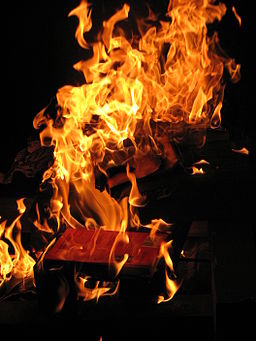
256px-Book_burning I’ve read some books I didn’t particularly like. I’ve read some books that I thought had many technical and craft-related flaws. I’ve written reviews on some of those books.

I’ve never felt the need or desire to destroy an author or their book in one of those reviews. I don’t think it’s necessary, professional, or entertaining.

I’m not writing this post because I’ve received any sort of review like this for my own work (or if I have, I’ve been lucky enough not to see it!). But I’ve read some others lately that alternately make me cringe, and make me angry. Have you seen reviews like this? Where the reviewer seems to take a sick delight in completely eviscerating the work–and by association, of course, the author? They can be cleverly written, sure. But their vitriol against the book is actually repulsive. I’m not going to do any of them the service of linking to them. Sadly, they’re not all that difficult to find.

Yes, there are probably more flawed books available now than there ever were before (although don’t think they don’t/didn’t exist inside traditional publishing since its inception). But I don’t know what can prompt a “reviewer” to write such a screed. Even if you think a book is the worst piece of drivel ever written, that opinion doesn’t give you the right to decimate another human being. You can discuss the flaws you found in the book; you can discuss why it didn’t appeal to you; you can even make suggestions for what would have improved it for you. Those thoughts might be helpful to an author in writing another book, and they might be helpful to other readers in deciding whether to read a book.

But if you’re not writing a review with those goals in mind, why *are* you writing it? If it’s to make yourself look clever and rapier-witted at the cost of destroying someone else–you’re just another online bully. And your credibility with me is a big fat zero.

Photo credit: By Patrick Correia from Northampton, MA, United States (Book burning Uploaded by mangostar) [CC-BY-2.0 (http://creativecommons.org/licenses/by/2.0)], via Wikimedia Commons

“A is for Apocalypse” Cover Reveal

Today I’m pleased to be one of the blog hosts of the cover reveal for A is for Apocalypse. I love the idea of this anthology (and the idea of the series, of which this anthology is the first title). Would I want to edit it? Heck, no! I stand in awe of editor Rhonda Parrish for taking on this Herculean task.

So what is this task? I hear you asking. Well, in a nutshell:

What do you get when you take twenty-six amazing writers, randomly assign them a letter of the alphabet and give them complete artistic freedom within a theme?

A is for Apocalypse

A is for Apocalypse contains twenty-six apocalyptic stories written by both well-known and up-and-coming writers. Monsters, meteors, floods, war–the causes of the apocalypses in these tales are as varied as the stories themselves. This volume contains work by Ennis Drake, Beth Cato, Kenneth Schneyer, Damien Angelica Walters, K. L. Young, Marge Simon, Milo James Fowler, Simon Kewin, C.S. MacCath, Steve Bornstein and more!

Editor’s Note: Keep reading, kids, there’s a giveaway further down!

What’s so Herculean about that? you’re asking now. Sure, twenty-six stories is a hefty anthology to edit, but longer anthologies have been done before.

Well, the rumour (and I believe it’s quite true) is that Ms. Parrish plans to edit an anthology for each letter of the alphabet, each with a new theme, and each containing twenty-six stories. So that’s, um…*gets out calculator, pokes in numbers, scratches head, pokes in numbers again*…that’s six hundred and seventy-six stories for the series. Phew. Having edited a mere sixty-two stories myself (and co-edited, at that), I can appreciate the enormity of the undertaking.

Well, come on, where’s the cover?

We’re getting there. First, you might like to read the answers to this question, posed by Rhonda to some of her writers:

In choosing a theme for this, the first of a series of anthologies, I considered and rejected a great many “A” words. Tell us about your favourite word that begins with the letter A.

Alexis A. Hunter – As an author — ‘acceptance’ has a beautiful ring to it. As a sci-fi writer — ‘apex’ is particularly engaging. In general — ‘angel’ is one of my favorite words, because they’re one of my favorite ‘creature types’ to play with in stories. Plus I have a thing for wings and feathers.

Damien Angelica Walters – My favourite word that begins with the letter A is anathema. It rolls off the tongue like a whisper, hiding its dark meaning in pretty syllables.

Simon Kewin – My favourite A word is (possibly) Archaeopteryx. I love the shape of the word. It’s exotic and fantastical and ungainly all at the same time – a little like the creature itself. It derives from the Greek archaeo (ancient) and pterux (wing). So, “Ancient Wing”. Archaeopteryx is a lovely illustration of the forces of evolution in progress; it’s a snapshot of a species in the process of changing from dinosaur ancestor to modern avian descendent. Here was a creature with a bony tail and teeth and feathers. And claws on its wings. I’d love to have seen one…

C.S. MacCath – My favourite ‘A’ word is ‘atonement’, because unlike ‘forgiveness’, it places the onus for righting a wrong where it belongs; upon the head of the person who committed it. If we were socialized to atone as much as we are already socialized to forgive, we might learn to be more careful with one another.

Okay, okay, very interesting. Now can we see the cover?

Oh, all right. I’ve made you wait long enough. We writers know the value of a good bout of anticipation, you know. But here it is! (You can click it to see it full-size.)
AisforApocalypse

I think A is for Amazingly Cool. :)

Here’s a little more about the book:

“In A is for Apocalypse, the world ends in both fire and ice–and by asteroid, flood, virus, symphony, immortality, the hands of our vampire overlords, and crowdfunding. A stellar group of authors explores over two dozen of the bangs and whispers that might someday take us all out. Often bleak, sometimes hopeful, always thoughtful, if A is for Apocalypse is as prescient as it is entertaining, we’re in for quite a ride.” – Amanda C. Davis, author of The Lair of the Twelve Princesses

“Editor Rhonda Parrish gives us apocalyptic fiction at its finest. There’s not a whimper to be heard amongst these twenty-six End of the World stories. A wonderful collection.” -Deborah Walker, Nature Futures author.

 A is for Apocalypse / Edited by Rhonda Parrish / Poise and Pen Publishing / ISBN-13: 978-0993699016 / ISBN-10: 0993699014 / Cover Designed by Jonathan Parrish

Available August, 2014

Hey, what about that giveaway?

I didn’t forget! Here’s what Rhonda says:

Giveaway

I’m giving away three ARC copies of A is for Apocalypse (tour-wide). These are physical copies but I am willing to ship them to anywhere in the world. The Rafflecopter draw will run from May 12th to May 19th. On May 20th I will choose three winners and email them in order to get their shipping address. Anyone who doesn’t respond by May 27th will forfeit their prize and I will choose a new winner to receive it.

The Rafflecopter Giveaway is here. So go, enter! What are you doing still hanging around here?


Judging Books, Judging Publishers

technical-drawing-551376-m

Details count!

We all know the old adage, “Don’t judge a book by it’s cover.” We all know it, but we all do it anyway, right? I find it very hard to bring myself to read a book with an ugly, ill-conceived, or poorly-executed cover. Why? Because the amount of care and attention paid to the cover sends a message about the amount of care and attention paid to the contents.

Yes, of course it’s possible to have a great book hidden behind an ugly cover. But you have to find readers willing to take the chance. I suspect a lot of decent books suffer this way, and don’t get the readership they deserve.

However, today I’m not searching for something new to read. Today I’m searching for publishers to submit to. And I’m here to tell you that I’m judging them by their covers. The covers they put on the books they publish.

There are a lot of factors that I consider–that I expect most writers consider–when deciding where to submit their work. Turnaround time is a big one for me, because I now make it a policy to leave manuscripts in submission (without a decision) for no longer than a year at the outside. Sure, I know that in publishing terms a year is not that long, but I’ve been burned before and I’m not going to do that again.

Payment is also a big one. Many publishers list their royalty structure right on their websites now, which I think is great. No surprises down the road after a long time waiting for an answer. I also have limits below which I won’t go on that score, because if a publisher does not value my work, I don’t trust them to help me attract readers.

Other considerations: I like publishers that accept simultaneous submissions, although it’s not a deal-breaker. I like publishers that accept attachments, although ditto. I like publishers that deal in both print and ebook, although I might consider ebook only if other aspects are attractive. I have little use for publishers who don’t plan to answer me unless they’re interested. And I might break my own rules on any of these things depending on circumstances.

But these days, I’m not even *looking* at any of these details first. The first thing I do when I scope out a potential publisher is go and look at their current catalogue and see what their covers are like. And if those covers are–to put it bluntly–crappy, then I don’t bother looking any further.

Maybe that sounds snobbish, like now that I have one book published, I’m full of myself. That couldn’t be further from the truth. I just think that especially now, in the days of shopping mega-bookstores online, where book cover thumbnails have about eight seconds to catch the eye of a potential reader, it’s the single most important element in getting a reader’s interest.

Some may argue that the most important element is price, but I beg to differ. Even at .99 or $2.99( or whatever the magical perfect ebook selling price is this week), a bad cover is not going to interest a reader in making even a small investment. Not when there are hundreds of beautiful, intriguing, eye-catching covers out there at the same price.

Some may also argue that it’s a matter of taste, to which I will agree–conditionally. Not even the most deftly-executed cover is going to make me pick up a horror novel. But I believe that even readers who profess to have no artistic appreciation will be turned off by a bad cover. Bad covers look cheap. They may be confusing. They’re often unreadable. They just don’t sell books, and after all, that’s their job. A cover is supposed to say “what lies within here is something you want to experience.” They won’t work if they say “we just didn’t have the time/money/talent/experience to make this look good. But spend your money anyway. What’s inside is better!”

If you don’t believe me, there are numerous curators of bad book covers around the Internets: like here, here,and here. Take a look and tell me if you really want to read these books. And would you really want your own book to join them?

Photo credit: mailsparky

The Writer’s Ladder of Success

ladder

Look up…look waaaaaay up….

A long time ago, in 2001, when ebooks were barely a “thing” yet and the only format for them was .pdf (ancient history, I know), I self-published an ebook for writers. It was called The New Writer’s Guide to Just About Everything and yes, it’s still around, although it’s sorely in need of an update and a new edition. Another thing on my too-long to-do list. But I digress.

Today I am thinking about a piece in that ebook, titled “The Writer’s Ladder of Success.” In it, I talked about how some new writers think their first sale is the top rung of that ladder, but in reality, that’s only a few steps up. Writing, I said, is the first rung. Finishing is the second. Submitting is the third. You may be stuck on that rung of the ladder for a while before you can climb up to the next one, which is making a sale. That analogy still holds true, I think.

Then, I said, you climb back down and start climbing all over again, writing, finishing, submitting. I think now, with the wisdom and experience of my years of writing (stop laughing!) I’d look at it differently. I think instead of climbing back down, I’d say we can look at it one of two ways: either we go sideways onto another ladder and start climbing from there, or the ladder we started on just keeps going, stretching up into the distance ahead of us. Either way, we’re not starting from scratch; we’re building on what we’ve already accomplished in order to climb to greater heights. Some might find that long, long ladder too daunting to look up at, and like the idea of shorter ones that lead to another, so either way works.

And either view is far more encouraging than feeling like you’re starting every piece from scratch. Of course that’s true in a way, since each writing project is new and comes with its own unique challenges. But we always have the comfortable cushion of our past accomplishments to buoy us up as we tackle the new.

There’s a saying that a writer is only as good as his or her last book. It’s true that we’re often judged that way–and we have to keep our fans happy or we’ll lose them. That’s a lot of pressure, though. I think we’re much more likely to succeed if we continue to feel good about our past successes–and not lose sight of that part of the ladder we’ve already climbed, stretching away below us. One bad song doesn’t make a failed musician; one strikeout doesn’t make a failed baseball player. Why do we hold ourselves as writers to a stricter standard? Why do critics and readers? I’m not really sure.

I closed out that section of the ebook by saying, “…you were a writer from the time you reached that first rung. Don’t let anyone tell you the ladder is not yours to climb.” I think that’s still good advice. I don’t think I’ll change that, should I ever get around to producing a second edition of The New Writer’s Guide.

Keep writing. Keep climbing. Build on what came before. Good advice, and advice I have to keep reminding myself of as I tackle a new project and a new deadline. Because frankly, I like the view from up here.

Photo credit: mensatic

The Writer’s Test Kitchen

pizza-oven

Some things cook, and some things burn.

I don’t know about other writers, but I, for one, am always looking for a better recipe for writing success. Of course, no single recipe is going to work for every writer, and sometimes it takes a lot of trial and error before you find the combination of ingredients that works for you. Thus, the writer’s test kitchen.

Admittedly, we’re all working with a lot of the same ingredients. Twenty-six letters, check. Determination, check. Imagination, check. Mad wordsmithing skills…hopefully. But that’s not really what I’m talking about. I’m talking more about the practical methodologies, strategies, tricks, lies, and motivators we use to get the job done.

This year, as I mentioned previously, I’m working at being more consistent, and less procrastinate-y. (Is that even a word? If not, I’ve just coined it. Feel free to make use of it as you will.) So here are some of the ingredients I’m cooking up in my test kitchen to see what comes out of the oven at the end of the year:

One daily dose of writing at 750words.com. Yes, I’ve experimented with this ingredient before. It’s got a lot going for it: privacy, motivation, cute badges to earn, reminder emails. I think my longest streak prior to this attempt was 46 days, so I’m out to beat that, at least. 46 days is 34,500 words right there, so whether I use it for blogging, fiction, private rants, or stream of consciousness, it’s productive.

Public goals. Yep, I’m telling the world that I’m finishing some stuff this year. This is a good motivator for me, because I really hate to look like a failure. In anything. Ever. (Note that I have not yet said how many things I will finish this year. Because, see previous sentence.)

Treadmill desk. Although I logged a goodly number of miles at the treadmill desk at the beginning of last year, I did fall off (although not literally) as the year progressed. There were many reasons for this, which I will not bore you with here. However, I have found that I am generally highly motivated to keep writing as long as I keep walking, which should prove useful in trying to be more productive. Also, benefits health-and-weight-wise.

Storylines. Nothing helps me wrangle a manuscript into shape better than doing an index card layout in Writer’s Cafe Storylines. I can visualize the entire story arc, see where characters appear, note the flow of plots and subplots, and insert revision notes exactly where they have to go.

Nirvana app. This little online beauty is great at helping keep goals, lists, and next actions organized and focused. It works on the Getting Things Done principle, and I started using it partway through 2013 with pretty decent success. I’m hoping it will help me stay organized, focused, and also keep me from getting bogged down in those not-writing things.

Evernote. Invaluable for storing notes, ideas, lists, and everything else I will need to keep organized. I use it in conjunction with Nirvava because I like to use Nirvana for time-sensitive things, but Evernote is for, well, everything.

A batch of unfinished manuscripts. Of course, a core ingredient if this is to be the Year of Finishing. I’ll have to vet, assess, and categorize these right off the bat, to see how they might each fit into the yearly plan. For this, I’ll likely use Evernote.

Add all ingredients, mix well, and bake in a consistently hot oven for a year. We’ll see what tasty treats emerge at the end.

Photo credit: Lotus Head