New Call for Submissions

Third Person Press has just posted a new call for submissions. We’re excited to be undertaking a third volume of speculative fiction from Cape Breton, this time to be titled “Unearthed.” We’re currently looking at having the current volume, “Airborne,” ready to release in October, so we’re busy, busy, busy!

Full submission guidelines for “Unearthed” can be found at http://www.thirdpersonpress.com/submissions.html. We’ll be open to submissions from June 1st to December 31st, 2010.

This time we’ve also added a page of expanded guidelines to the Third Person Press website. Our biggest reason for doing this was that we’ve encountered one main reason for rejecting stories in the course of the two anthologies we’ve done so far–we get a lot of stories that simply aren’t speculative. To that end, we’ve written some guidelines that will (we hope) give writers a little better idea what we’re looking for.

Read an eBook Week

This coming week, March 7th to 13th, is “Read an E-book Week.” In recognition of this, I’m making one of my stories available free, just this week, in electronic format.

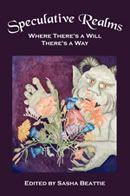
The story is “Summer of the Widows,” which was first published in the anthology Speculative Realms: Where There’s A Will, There’s A Way, by Speculative Realms in 2008. The anthology is available in print from Amazon and in various electronic formats at Smashwords (for just $1.99!), and if you try out my story and like it, I’m sure you’ll like the rest of the stories in the antho as well.

You can find a .pdf of “Summer of the Widows” right here, or click here to read the .html file online.

Enjoy!

Revision Paranoia

Photobucket I’ve come to the point in this revision where I’m hearing voices in my head.

They’re saying things like, “This novel stinks,” and “It’s brilliant but not marketable,” and “It has more holes than last year’s socks,” and “This is a big waste of time you could be spending on other things.” In other words, it’s getting to be hard work, and my brain doesn’t want to do it any more.

Which is not to say that any or all of these things are not true. They could be. But I’ve come to the conclusion, through my own writing and by reading what other writers say about their experience, that I am not the best judge of that at this time. My job right now is to finish the thing, and show it to someone else–probably several someone elses–before I even start to think about it solely on its merits.

And before I can do that, I have to finish it. So off I go.

A Word on Definitions

No progress on the revision today, as I expected. However, we did have a productive Third Person Press meeting tonight and discussed some rewrite requests.

I also began writing a page of extended guidelines for TPP. One thing that we have noticed with some regularity is that many writers do not understand what we mean when we talk about “speculative fiction.”  Our calls for submission have always included the further clarification that we are looking for “science fiction, fantasy, horror, magic realism, and paranormal (for example, ghost stories).” Despite this, we still get quite a number of submissions that contain no speculative elements at all.

To address this problem, we’re adding this page of extended guidelines to the TPP site, and encouraging writers to read them before submitting. I know, I know. We will still get submissions that are not speculative. But the hope is that this will cut down on them to some extent.

I started in writing with a good will, but soon discovered why it’s so damn difficult to come up with a definition of speculative fiction that everyone agrees on–it’s even difficult to come up with one that serves our very narrow purpose. We’re not attempting to define the genre for everyone, just setting out what we are looking for vs. what we are not looking for, and even that’s hard. The field is so very broad, the sub-genres so very many, the possibilities so multitudinous, that one can’t include all the possible permutations. On the flip side, it’s also difficult to define what is not speculative fiction in such a way that we don’t accidentally preclude stories that we would like to see. The best I’ve come up with so far on that front is, “There is nothing in the story that steps outside the boundaries of accepted reality.” I think that might be too broad and too vague to be helpful.

I expect I will be working on this guidelines page through several drafts. Maybe I’ll have it done in time for our next project!

Writing Log Update and Phase Two

Photobucket The writing log did not, as I suspected, end up in any better shape by the end of Sunday than it looked on Friday. I logged 294 out of a goal of 630 minutes of writing time. Discouraging. But–on to a new week.

Thus far things are looking better. Today I dove into the revision first thing this morning (well, after I slept in), and worked on it intermittently through the day. Thus I have 194 minutes logged already, and I’m through eight scenes incorporating changes and adding things. It’s flowing well, and despite the weekend break I still feel I have a good handle on the novel in its totality and what things need to happen. Interesting things I had to do in relation to the revision today included reading poetry by T.S. Eliot and Percy Bysshe Shelley, investigating brain function, and considering the possible side effects of an invented medication (being married to a pharmacist came in extremely handy at that point, as you can imagine).

Tomorrow will be school library day, and then I believe a Third Person Press meeting in the evening, so it is not likely to be nearly as productive. In fact, I will feel lucky to get any revision time in at all. But we’ll see how it goes. I am not revising my goal time back down after last week’s poor showing; I’ll stick with the new time until I get it.

On a side note, I spent far too much time today (and yesterday) trying to figure out and keep up-to-date on the Amazon and MacMillan brouhaha. I’m still in the My Head Hurts Trying To Fully Understand it All camp, and likely to stay there despite reading many illuminating blog posts and commentaries. My only conclusion is that the ebook battle has scarce begun, and there looks to be no clear end in sight.

This is working so much better…

Photobucket After the poor showing of the past two weeks with regard to writing time, this week I’m taking a different approach. I’ve blocked off time each day that is my “work time.” I have told my family that during this time I should be considered to be “at work” and more or less unreachable (emergencies notwithstanding, of course).

And it seems to be working. Today I had to re-arrange my schedule to deal with some ROML* stuff, but I still got the time in on my revision and a short story. Although it’s been only two days, this is very encouraging to me.  I am finding much to clarify, add, or improve upon in the novel revision (more than I’d hoped?  Admittedly yes.  But nothing I can’t handle, so far).  I am doubtful I can accomplish the revision in the three week time frame I was aiming for, but the plan is to simply keep working through it at a reasonable pace and see where that takes me.

In other news, the Destination: Future anthology (releasing soon!), which includes my story “Encountering Evie,” received a starred review from Publisher’s Weekly! In case you don’t know what that means, it’s a good thing. :)

*Rest Of My Life

About that Sparkly Thing

Photobucket Yes, this is a blog post about sparkly vampires, but it might not be what you’re expecting.

A disclaimer first: I haven’t read Stephenie Meyer‘s Twlight series. I did see the first movie.

Meyer has come under a lot of fire for her portrayal of vampires (I’m sure she’s crying all the way to the bank, but it’s something I’ve been thinking about). Her vampires fall outside the “norm” of traditional vampires in many ways, including the way their skin sparkles. People who aren’t fans of the books really seem to hate that and poke fun at the idea quite relentlessly.

I’m neither a fan nor an anti-fan, and I think Meyer is simply following a piece of writing advice that gets handed out to writers (especially genre writers) all the time, and it’s this: take an old idea, and put a new spin on it.

We’ve all seen or heard about those lists–there are only seven plots, there are only twelve plots, etc. We’re told there are no new ideas, there are no new conflicts, there are no original stories. There are only new takes on old stories. It’s up to us to take an idea and set it in a new light, twist it, change it, give the reader something different.

Isn’t that exactly what Meyer has done?

Okay, granted, maybe the sparkly thing was not the best execution of this advice. Maybe it flew too directly in the face of accepted vampire lore and the things that dyed-in-the-wool vampire fans were going to be looking for in her stories. Maybe it set the author up for too much easy criticism from those who didn’t like the books. In a way, it’s so different, so “out there,” that it makes for an easy target for such criticism.

On the other hand, there are now a lot of readers out there reading vampire fiction–all sorts of vampire fiction–that they would never have picked up if Meyer’s books hadn’t introduced them to the dark seduction of the vampire mythos. If nothing else, it certainly hasn’t hurt the books’ appeal or sales.

I think genre writers would be wise to look at this an example of a writer taking a piece of standard writing advice and using it to very good effect.

Thanks, Tor.com!

As some of you may know, October was Steampunk Month over at Tor.com. The month was jam-packed with interesting blog posts, steampunk tips for DIYers, beautiful free wallpapers, and tons of giveaways. I didn’t stumble upon things until at least partway through the month, but then I entered every giveaway after that.

And, I won one!

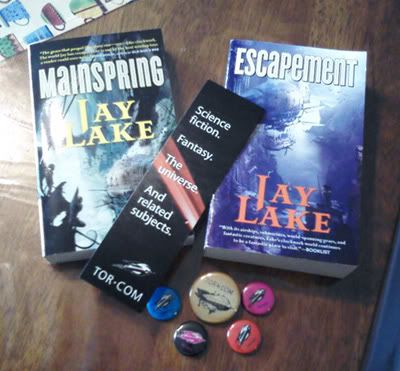
My copies of Jay Lake‘s Mainspring and Escapement arrived in the mail today, quite promptly I must say. Also included in the parcel were a Tor bookmark and a handful of buttons, so it made a nice little prize package.

Jay Lake prize package from Tor.com

I was especially pleased to win this prize, because I am a big fan of the columns Jay Lake writes (often with Ruth Nestvold) over at IROSF (I always snag this one to proofread when I can!). If you are not familiar with the columns, I recommend you click over and check some out. They are available in the archives, many under the “features” tab, and are easy to find. Sadly, I haven’t had an opportunity to read enough of his fiction, so I’m really looking forward to these books. They may even jump the line in my TBR pile, since I just finished reading George Mann’s The Affinity Bridge last night and need something new to add to my being-read list.

But when is it ready?

Yesterday morning I opened an email from a publisher I’d queried about The Seventh Crow. To my delight, they were requesting a look at the full manuscript.

Now, this manuscript has been pretty thoroughly edited, revised, redrafted, read by three trusted readers, run through the trusty Cliche Cleaner, etc. I made sure it was ready before I even thought about sending out queries.

Or so I thought. To make the submission, I had to convert the file to MS Word, so I thought, “might as well run it through Word’s spell/grammar check, too.” Two days later, I have just now sent the file out.

Now, much of this is due to the fact that Word’s grammar checker is…weird. I know, I know, this is one of the most difficult things to program because of context issues, style issues, usage variations–but still. Of everything it flagged, I would guess I changed less than one-eighth. Don’t get me wrong–I am not saying I know better than the program when it comes to strict right-or-wrong questions. It was useful to me in pointing out a number of things I’d missed along the way. But the vast majority of issues it flagged were non-issues. Hence the two days it took to go through 324 pages (and not counting kids, puppies, husband, laundry, meals, and sundry assorted other distractions, of course).

At any rate, the real point of this post is in the title…how does a writer know when a piece of writing is ready? Really ready to go out into the world and stand on its own?

Two answers spring to mind for me: feedback and critiquing. I think it’s extremely important to have some trusted readers (or at least one!) who will provide honest feedback on a story at various stages, and who have some facility with the technical end of writing–who can tell you that you’re using too many passive sentences, or semicolons, or that you’ve used the word “recalibration” three times in two paragraphs. And of course, you have to be willing to listen to them.

Conversely, you need to develop your own critiquing skills by reading and commenting on the work of other developing writers. It’s the best way I know to become a good self-editor, which is one of the most difficult skills to master; and in today’s publishing world, one of the most important. It is crucial to be able to bring your own work to a highly polished level before submitting it. By critiquing stories for other writers, you learn to view the work with a detached eye, and in time will be able to apply a similar level of detachment (although never quite the same) to your own stories.

But still…when is it ready?

Honestly–I don’t know. Some say, if you’re changing less than 10% of the words, send it out. Some say, when you feel like you can’t improve it any more on your own, send it out. Some say, when you can’t stand to read the damn thing one more time, send it out.

All good advice. I think the main thing to take away from this post is that you make the work the best you can, and then you send it out. And then…you cross your fingers and wait.

Less than 46 cents per story!

Last year I was pleased to have my short story, “Summer of the Widows,” appear in an anthology titled Speculative Realms: Where There’s a Will, There’s a Way. It’s a wonderfully eclectic mix of fantasy, science fiction, and horror stories from a global collection of writers.

In “Summer of the Widows,” one of my recurring characters (a young female wizard’s apprentice with a knack for attracting trouble) is suspected of murder, and must find the real killer AND save her master from an even more dangerous threat–marriage!

Right now, I see that Amazon.com is offering the anthology for a sweet $5.88. That’s less than forty-six cents per story for the thirteen stories in the book. At that price, I’d suggest you get it while it’s hot!